
 9 Oct 2026
  9 min read

 Danny Wall
Standard MDF does the job in dry rooms. Moisture-resistant MDF is the board to use in kitchens, bathrooms, utility rooms and anywhere else that sees steam or condensation. Most jobs come down to a choice between those two, so this guide covers what each MDF board is for, how to tell them apart, which thickness to pick and where MDF shouldn’t be used at all.
What Is MDF?
MDF stands for medium density fibreboard. It’s a sheet material made by breaking timber down into fine fibres, mixing them with resin and wax, then pressing the mix into flat panels under heat. The result has no knots and no grain, so it behaves the same way across the whole sheet.
Trades use it because it:
- Stays flat and doesn’t twist or cup like solid timber can.
- Cuts and routs cleanly, with no splintering along the grain.
- Takes paint well once it’s primed.
- Costs less than plywood or hardwood for painted work.
MDF sheets are sold at 2440 x 1220mm, which is the standard 8×4, in a range of thicknesses.
The Main Types of MDF
There are several MDF types on the market, but only two turn up on most domestic jobs. The table below shows how the common types of MDF compare.
| Type | How to Spot It | Where It Goes | Where It Doesn’t Go |
|---|---|---|---|
| Standard MDF | Tan or light brown all the way through | Dry interior joinery, furniture, shelving, panelling | Kitchens, bathrooms, outdoors |
| Moisture-resistant MDF (MR MDF) | Usually a green tint in the core | Kitchens, bathrooms, utility rooms, window boards | Outdoors, standing water |
| Fire-retardant MDF | Usually a red or pink tint | Commercial and public buildings where a fire rating is specified | Damp areas, unless rated for both |
| Veneered or melamine-faced MDF | Timber veneer or a hard white or coloured face | Cabinet interiors, furniture you won’t be painting | Jobs that need the face painted or routed |
Standard MDF
Standard MDF is the general-purpose board. It has a tan or light brown core and a smooth, sanded face, and it’s what most painted interior joinery is made from. Typical jobs include:
- Bedroom wardrobes and alcove units.
- Shelving in living rooms, bedrooms and offices.
- Wall panelling in hallways, lounges and bedrooms.
- Skirting and architrave.
Its weak point is water. If standard MDF gets wet, it swells, and it doesn’t shrink back when it dries. Cut edges go first because they soak up moisture much faster than the face.
Density also varies between boards. Lighter boards are easier to carry but tend to leave a rougher, more fibrous edge when routed, so ask what you’re getting if the job involves profiled edges.
Moisture-Resistant MDF
Moisture-resistant MDF is made with a resin that repels moisture, so the board swells far less in humid air. You’ll also hear it called MR MDF or green MDF. It cuts, routs and paints the same way as standard board, and it’s the right choice for:
- Kitchen plinths, end panels and carcasses.
- Bathroom panelling and vanity units.
- Utility room shelving and cupboards.
- Window boards.
- Boxing in pipework.
Moisture-resistant does not mean waterproof. MR board copes with steam, condensation and the odd splash that gets wiped up. It won’t cope with standing water or rain.
Fire-Retardant and Faced Boards
Fire-retardant MDF is usually tinted red or pink and is specified for commercial and public buildings. If a job calls for it, check the fire classification on the manufacturer’s data sheet against the specification before you order.
Veneered and melamine-faced boards come with a finished surface, which saves time on cabinet interiors and furniture that won’t be painted.
Standard or Moisture-Resistant MDF: Which to Choose for Your Job
The simplest way to choose is to think about the room and how the board will be finished.
| Job | Board to Use | Why |
|---|---|---|
| Bedroom wardrobe carcass | Standard | Dry room, painted or faced finish |
| Alcove shelving | Standard | Dry room, no exposure to steam |
| Lounge or hallway wall panelling | Standard | Dry room, fully painted |
| Bathroom wall panelling | Moisture-resistant | Regular steam and condensation |
| Kitchen plinths and end panels | Moisture-resistant | Mopped floors, spills and steam |
| Window boards | Moisture-resistant | Condensation runs off the glass onto the board |
| Boxing in pipes | Moisture-resistant | Pipes sweat and occasionally leak |
| Unheated garage or shed shelving | Moisture-resistant | Damp air through winter |
| Skirting and architrave | Standard in dry rooms, MR in kitchens and bathrooms | Depends on the room |
MR board costs more per sheet than standard, so there’s no need to use it throughout a house. Ask at the trade counter for the current price difference before you price the job.
Some joiners use moisture-resistant MDF in dry rooms as well. Their reasoning is that it tends to be a denser board, which gives a cleaner routed edge and a smoother painted finish. That’s a trade preference, not a rule, but it’s worth considering on shaker doors or anything with a lot of moulded detail.
Why Is Some MDF Green?
Green MDF is moisture-resistant MDF with a dye added at the factory. The colour lets you tell it apart from standard board in the yard, on the van and on site, including after it’s been cut.
The dye is there for identification and doesn’t provide the moisture resistance itself. Not every MR board is green either, so check the label or ask if you’re unsure.
Which MDF Thickness to Use
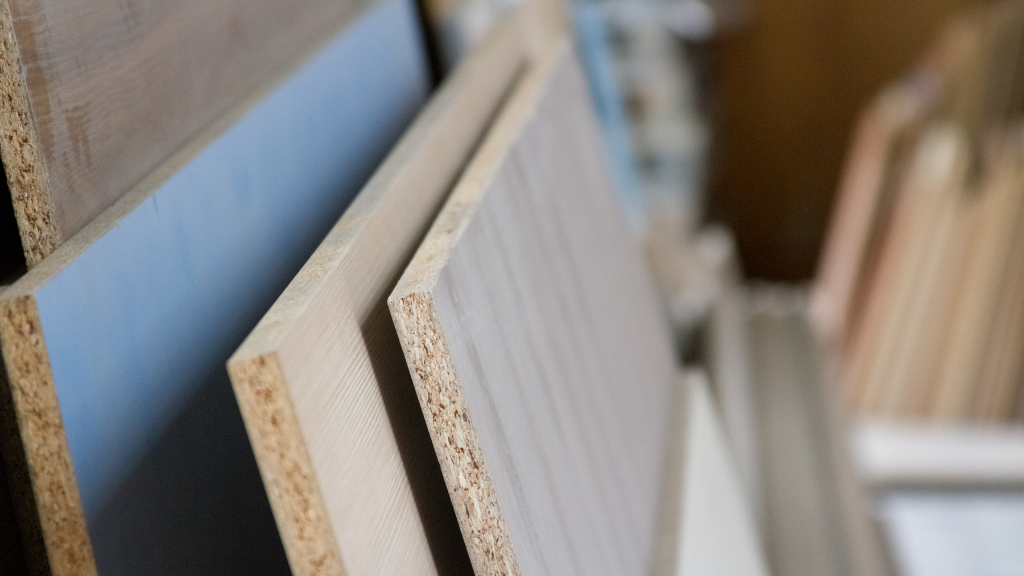
MDF thickness affects how far a board will span, how well it holds a fixing and how much it weighs. These are the common thicknesses and what they’re used for.
| Thickness | Typical Jobs |
|---|---|
| 6mm | Cabinet backs, drawer bottoms, shaker strips, templates |
| 9mm | Wall panelling, boxing in, bath panels |
| 12mm | Panelling, light carcass work, small doors |
| 18mm | Carcasses, shelves, cabinet doors, window boards |
| 25mm | Long shelves, workshop tops, deep window boards |
A few pointers:
- Use 18mm or 25mm for shelving. Thinner boards sag under load.
- On shelf spans over about 800mm, add a timber lipping to the front edge or a support underneath.
- A full 18mm sheet is heavy, so treat it as a two-person lift.
If you’re working out sizes for the rest of the job, our guide to timber sizes covers sawn and planed sections.
Where MDF Should Not Be Used
MDF has limits, and it pays to know them before you buy.
- Outdoors. Neither standard nor MR board is made for rain or ground contact.
- Standing water. Shower enclosures, wet room floors and the area behind a sink need a different material.
- Structural work. MDF isn’t a load-bearing board. Use plywood or OSB for floors, roofs and sheathing.
- Unsealed edges in damp rooms. Even MR board should have every cut edge sealed.
Working With MDF on Site
Cutting
Use a sharp TCT blade and support the sheet on both sides of the cut. With a hand saw, cut with the good face up. With a circular saw, cut with the good face down so any breakout is on the back. The same approach applies when you cut skirting board to length.
Sealing and Painting
The edges of MDF are far more porous than the face, so they need extra work.
- Sand cut edges smooth.
- Seal them with an MDF primer or sealer.
- Rub down lightly once dry, then seal again if the edge still looks open.
- Prime the whole board.
- Apply your top coats.
This applies to MR board as well as standard. For more on paints, oils and varnishes, see our guide to finishes for timber.
Dust
MDF throws off a very fine dust when it’s cut or sanded. Cut outside where you can, or use extraction on the tool, and wear a P2 or P3 rated dust mask.
Fixings
Drill a pilot hole and countersink before driving a screw. Keep fixings away from the edge of the board, because screws driven into the edge can split it.
Storage
Store sheets flat, off the floor and somewhere dry until you need them. A board left leaning against a damp garage wall will bow. Our guide on how to store timber properly goes into more detail.
Getting the Right MDF Board From Your Merchant
Tell the counter three things: which room the board is going in, whether it’ll be painted, and the size or span you need. That’s enough to point you to standard or MR and the right thickness.
Skuma Timba stocks sheet materials for collection or delivery on our own vans within 65 miles of Scunthorpe. Need it cut to size? Just ask.
MDF FAQs
Is MDF Waterproof?
No. Standard MDF swells when it gets wet and doesn’t recover. Moisture-resistant MDF handles humidity and occasional splashes much better, but it still isn’t waterproof and shouldn’t be used outdoors or anywhere water will sit on it.
Can You Use Standard MDF in a Bathroom or Kitchen?
It isn’t advised. Steam and condensation get into the board over time, starting at the edges, and it swells and loses its shape. Use moisture-resistant MDF in these rooms and seal every cut edge before painting.
Are There Different Grades of MDF?
Yes. The main grades are standard, moisture-resistant and fire-retardant. In the UK, MDF is made to BS EN 622-5, which separates boards for dry conditions and boards for humid conditions.
Do You Need to Prime MDF Before Painting?
Yes. Unprimed MDF soaks up paint unevenly and the surface fibres lift, which leaves a rough finish. Seal the edges first, then prime the whole board before your top coats.
What Is the Difference Between MDF and HDF?
HDF is a high-density fibreboard. It’s made the same way as MDF but pressed harder, so it’s denser and usually thinner. HDF is mostly used for laminate flooring cores and door skins, while MDF is used for joinery and furniture.